


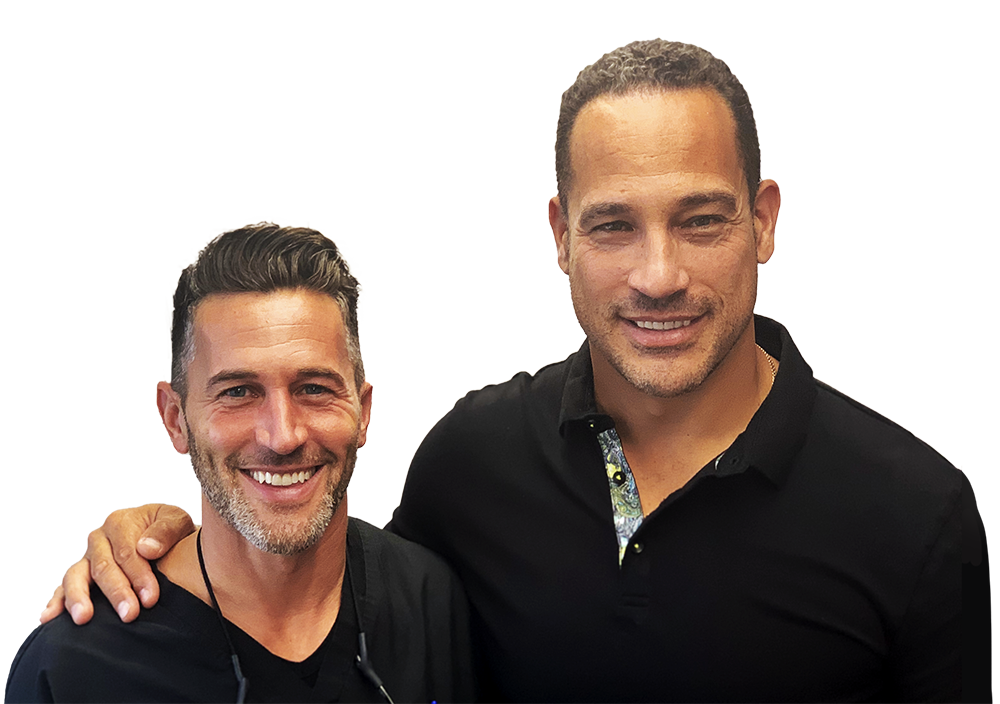
Television Host Josh McBride FUE Hair Transplant
Television host and entertainment personality Josh McBride underwent FUE hair transplant surgery with Dr. Matthew Lopresti and Dr. Robert Leonard after experiencing progressive hair loss in his twenties. His 2016 procedure transplanted his own donor hair into areas of permanent hair loss extending from the frontal hairline toward the pre-crown, giving Josh a long-term solution at a time when looking older than his age had become increasingly difficult to ignore.
For Josh, hair had never been background scenery. He was building a career in front of cameras, casting directors and audiences, where appearance gets noticed whether anyone talks about it or not. When his hair began thinning in his early twenties, the reflection in the mirror started telling a different story than the age on his driver’s license.
“I was beginning to look older than the parts I was auditioning for, much older,” Josh said. “Here I was trying to get roles as a 22 year old, and casting directors thought I was 30.”
He initially turned to Rogaine, also known as topical minoxidil, in an effort to maintain the hair he still had. But as his career grew, so did his frustration with his hair loss.
“I am my own worst critic,” Josh said. “It wasn’t about what other people were saying to me, but when I looked in the mirror I thought, ‘I look old.’ I just was not confident.”
 Josh’s career would eventually move well beyond those early auditions. He became a nationally recognized television host, producer and entertainment and lifestyle personality, appearing on programs including Today, Good Morning America, The Talk, The Wendy Williams Show, Sherri and PIX11. His work has put him across from celebrities including Kevin Hart, Sarah Jessica Parker, Adam Sandler and Heidi Klum. In 2026, he expanded his work with The McBride Rewind, an entertainment podcast built around candid conversations with actors, musicians and television personalities.
The career changed. The importance of being comfortable in front of a camera didn’t.
Josh began researching hair restoration doctors and eventually connected with Leonard Hair Transplant Associates. What appealed to him wasn’t a sales pitch about getting as much hair as possible. It was a conversation about what could realistically be done with his own donor hair and what would make sense for someone who had begun losing hair at a young age.
“I work a lot and told him exactly what I needed,” Josh said of his experience with the practice. “With Doc, it was never a sales pitch.”
In July 2016, Dr. Lopresti and Dr. Leonard performed Josh’s FUE hair transplant. Individual follicular units were removed from the donor area and transplanted from his frontal hairline toward the pre-crown area where he had experienced permanent hair loss.
FUE, or follicular unit excision, is a hair transplant technique in which individual follicular units are harvested from the donor area and placed into areas affected by permanent hair loss. The transplanted follicles are Josh’s own hair. Once established, those follicles retain the characteristics of the donor hair from which they came.
But moving follicles is only half the job. Knowing where to put them, how many to use and how much donor hair to preserve for the future is what turns a procedure into a long-term hair restoration plan.
That mattered for Josh because hair loss is progressive. A patient having a hair transplant in his twenties may continue losing surrounding non-transplanted hair for years afterward. Donor hair, meanwhile, is limited. There is no second supply waiting if too much is used too early. A well-planned FUE procedure has to address what the patient sees in the mirror today without forgetting what could happen tomorrow.
For someone whose face regularly appears in close-up, there was another standard the result had to meet. Good hair transplant work should not announce itself when the camera moves in. The objective was never to give Josh somebody else’s hair. It was to restore his own in a way that belonged on his face.
“It was a phenomenal experience,” Josh said. “Drs. Leonard and Lopresti are the nicest guys, and the whole process was quick and painless. Overall, it was just an enjoyable experience for me.”
What followed surprised him in a different way. Fixing the thing that had bothered him every time he looked in the mirror became a catalyst for changes that had nothing to do with follicles. Josh recommitted himself to working out, eating better and taking care of himself.
“The decision to have hair transplant surgery was really a decision to change my entire lifestyle,” he said. “Post-surgery, I started to regain my confidence and it really helped invigorate other parts of my life like eating healthier and exercising.”
That is where Josh’s story becomes more interesting than a simple before and after.
Hair restoration could change his hair. It couldn’t build his television career, conduct an interview or create an opportunity. Josh did those things himself. What the procedure addressed was something much simpler and more personal. He didn’t like what progressive hair loss was doing to the person he saw in the mirror, so he decided to do something about it.
Today, Dr. Matthew Lopresti is Chief Hair Restoration Surgeon at Leonard Hair Transplant Associates and personally performs both FUE and FUT hair transplant surgery. The practice treats men and women from Greater Boston, throughout Massachusetts and New England, as well as patients who travel from across the United States and internationally. Hair transplant surgery is performed in Newton, Massachusetts and Warwick, Rhode Island.
Not every person experiencing hair loss needs a transplant. Depending on the pattern and progression of hair loss, existing hair, donor supply, age and long-term goals, treatment may involve FUE, FUT or non-surgical hair loss options such as PRP with ACell, finasteride or minoxidil when medically appropriate. The point of a consultation is not to find a reason to perform surgery. It is to determine what makes sense while there are still choices to make.
Josh built a career interviewing people for a living. In this case, the important conversation was the one he finally had about himself.
He was young. He was losing his hair. He didn’t like where it was headed.
So he changed the ending.